Saxophone Work Fixture

•August 2, 2009 • 3 Comments

DSC01135

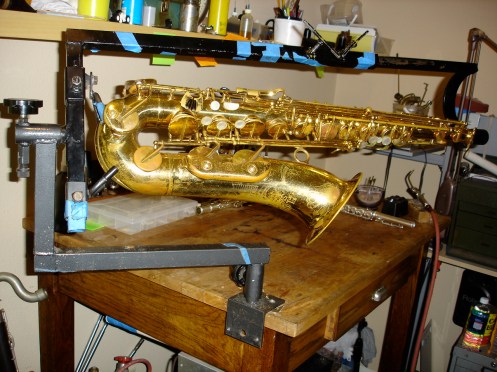
Pictured above is the single most useful saxophone tool that I own. This fixture safely and securely holds a saxophone, allowing me to free up both hands- no need to hold or cradle the horn while working on it. The fixture rotates, and the attached horn can rotate as well. The support arm has a hole through it that allows a florescent leak light to be used as normal. It was purchased from a now defunct supplier, but similar items can be obtained from both Votaw and Ferree’s. I have brought it to my friendly neighborhood welding shop to have a few repairs and modifications done on it over the years, most noticeably the double set of screws that hold in the support arm. Pictured below is the same fixture, with a different support arm so a baritone saxophone can be supported. In my second apprenticeship, my boss referred to baritone work as requiring hazard pay. The fixture takes alot of hassle out of any saxophone repair, but most especially the baritone.

If you are interested, these are both H-Couf saxophones, imported by Armstrong from the German Keilwerth factory in the mid-seventies. The tenor, a Superba I, has been my work horse since 1992. The baritone is a Superba 2, a project  that I have been working on sporadically for the last 3 years.

DSC01132

Flute Repad

•July 30, 2009 • Leave a Comment

DSC01123

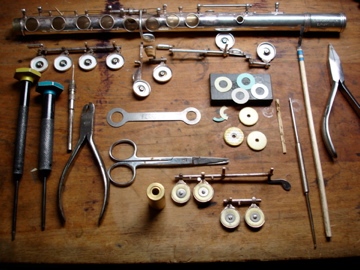
This is the main body of the Gemeinhardt I am currently rebuilding, along with the tools and pads that I use in this job. Next to the body you can see many of the keys, with their shims freshly glued in awaiting the pads. From left to right, the tools are:

  1. Two screwdrivers, with different size blades, purchased from Ferree’s.
  2. Pad Prick. It is a sewing  needle installed into a pin vice, used to pull pads out of cups when they need to be re-shimmed.
  3. Pin Pliers. These came from a watchmaker. Not sure of their original application, but I use them to remove and install key pins.
  4. Pad Iron. After screwing the center grommet in, the pad has to be ironed to remove the wrinkles. Also Purchased from Ferree’s.
  5. Scissors. Used to cut shims down to use in small pieces.
  6. Pad Cutter. This is the outer sleeve for Ferree’s cork pad cutting kit. I use it in flute work to compress the shims into the key cups after gluing.
  7. Shims. Here are four different sized shims, from left to right (the ones on the black block) are .05mm, .1mm, .2mm, and.3mm. Below the block are a couple of shim remnants – they might be used to level a pad. Purchased from J.L. Smith & Co.
  8. Pads. Lucien deluxe brand – quite possibly the best flute pad on the market.
  9. Wood stick. Used to spread glue on shims and in key cups.
  10. Spring Hook. Once a key is assembled, I use the hook to get the spring into place. Could be from Ferree’s, could be from Allied.
  11. Feeler Gauge. The BACKBONE of any flute work. This nine inch piece of balsa wood has a piece of biaxially-oriented polyethylene terephthalate (think silvery balloons) glued to the end.
  12. Pliers. Used to pull out or push in the hinge rods.
  13. Two Completed Key Segments. The B/Bb mechanism and the double G key.
  14. Not Shown:  The foot joint, the head joint, and the head joint crown assembly.

Bond. Clarinet Bond.

•July 29, 2009 • Leave a Comment

DSC01069

I once had a young clarinetist bring a horn that looked just like this into my shop. When I asked her what happened, she smiled sheepishly and told me her dog sat on it. Her nintey-five pound dog. Snapped the receiver on the lower joint right off.

These are the tools I use to clean the horn parts prior to rebonding them. It is a simple process that saves the customer hundreds of dollars as opposed to replacing the entire joint. There are four simple steps involved in this process: Clean! Bond! Clamp! Wait! The Armstrong clarinet in these pictures is now now enjoying another season of Texas High School Marching Band. Upon finishing this job, I did the same repair to a a couple of Vito Bass Clarinets.

How Not To Level A Saxophone Pad.

•July 28, 2009 • Leave a Comment
How not to glue a saxophone pad.

How not to glue a saxophone pad.

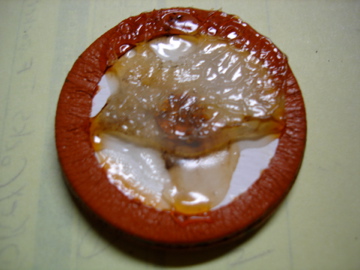
I pulled this pad out of a client’s Yamaha-62. (That is an alto saxophone.) She had just bought it and was assured by the seller that it had been re-padded “recently.” Most of the pads were in good shape, with just a few minor leaks. Then there was this one! It came off the low-C key, and was leaking terribly. I pulled it out thinking i would re-glue it, however its surface was too far gone. Sometimes it’s best just to start over. Ok, so enough back story, let me describe what you are looking at, and what is wrong with it.

What you see is the back of a saxophone pad. The top portion is covered with hot glue. Most repair techs, and manufacturers use some version of hot glue. That’s right, just like your Aunt Maybel uses in her arts/crafts! Notice how, even in the parts that are covered with glue, there are 2 huge gaps. Then there is the bottom of the pad. Almost no glue at all! The consequence of such unvenly applied glue is that the pad could not seat against the tone hole. When seating a pad, there are times that you want more (or less) glue to be under a specific part of the pad, that is how we “float” pads. With all of these gaps, this poor fellah never had a chance.