
Dried Out Head Joint Cork
you pull on the crown and the whole assembly come out. This particular example is from a Gemeinhardt M2, a fairly common student instrument.

Dried Out Head Joint Cork
you pull on the crown and the whole assembly come out. This particular example is from a Gemeinhardt M2, a fairly common student instrument.
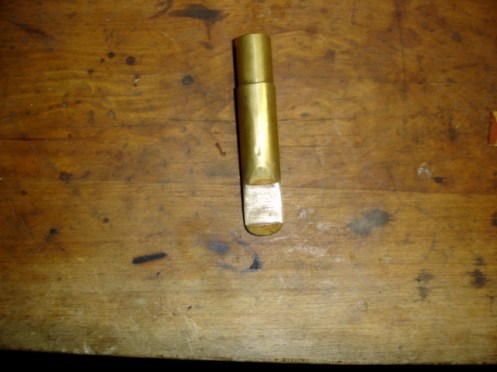
Mouthpiece missing teeth guard
This mouthpiece was custom made by Ken Beason in the early 1990’s. Ken left a large space in the top where a tooth guard belongs. Shown below is the attempt to fill the space using dental alginate. Will update this post in a few days with a report on how well (or not well) it works.
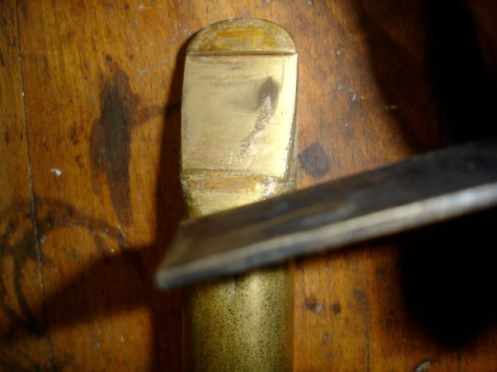
Cleaning the metal
Cleaning the surface with a piece of 600 grit sandpaper (glued to a saxophone key) This was followed by some isopropyl alcohol.
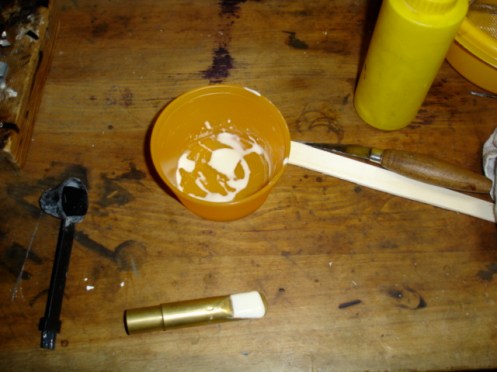
mouthpiece, mixing bucket and stirring stick.

Cleaned Shop
Spent most of today cleaning – moving furniture, wiping surfaces, sorting parts, vacuuming… Spring cleaning in September.
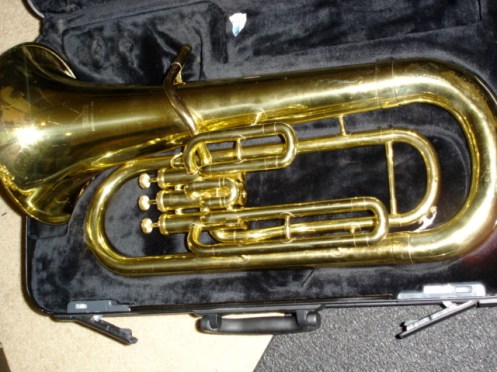
Funny looking saxophone
It was inevitable – someone brought me a euphonium. 2/3 valves will not go up and down. Fairly certain it is the valve guides, Yamaha guides fail if mistreated, and these sure look it.
In the past when asked if Inhorn does brass repair, I usually say no and send them to one of several friends in the area. Looks like that might be changing, as I am not in a position to turn down work.
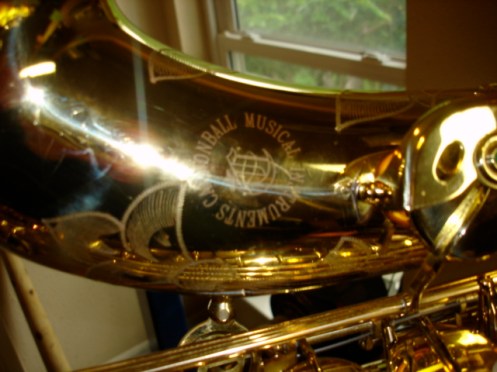
Cannonball Tenor Bell
I have always wanted an excuse to use that line.
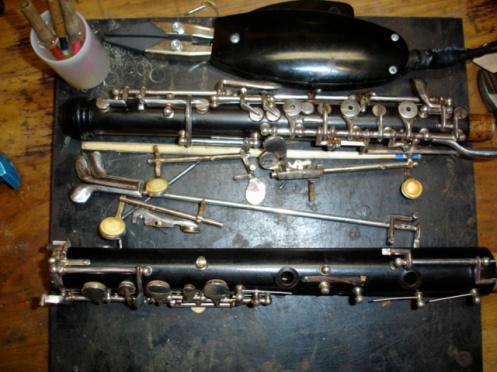 There is nothing more pathetic than a neglected school owned oboe. This Selmer wood oboe was in rough shape when it came in this morning. After pulling it apart, cleaning it out, replacing several (probably original) pads and key corks, it was assembled and adjusted. Then I commenced to play all the major scales on it. It has been since college that I put that much time into playing an oboe, I had forgotten the relative awkwardness of its’ key systems. So I repaired it, then it defeated me. Tie game.
Pictured above the oboe is a Votaw pad cup heater. Essentially a glorified soldering tool, it makes adjusting all those little tiny pads much easier than using a torch.

Lower Stack
Upper Stack

Rear View of Upper Stack
Bell Keys
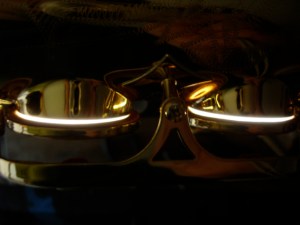
The most basic way to view leaks in a saxophone is with a leak light. While gently pressing down the keys the spots where the light comes out shows the spots on the pad where air is escaping. These pictures were taken in the dark without a flash to illustrate just how bad the leaks are. Normally this much pad work comes along with some obvious dents or bowing of the body. Strangely enough, this alto was purchased two years ago, and still looks great. Other than the bell being pushed aside, there is no obvious banging around, and in fact the lacquer on the horn is barely scratched.
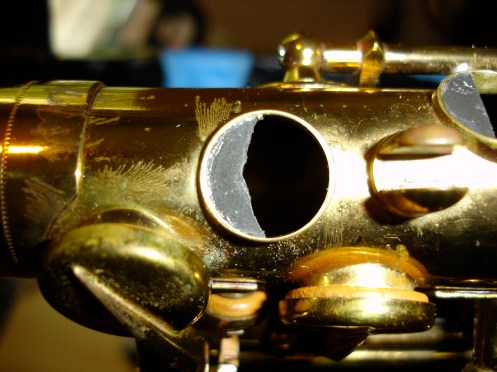
Lowering Pitch
Many saxophones, or saxophone players, have a tendency to go sharp in the upper range. Here in the shop I install materials into the tone holes to alter the intonation, in this case to bring down the pitch on the high-D through F on a Selmer Mk VII. This picture was taken at the beginning of the process – closing up the tone hole that much brings the pitch way too far down.

Saxophone Pad Work Meets Flute Pad Work - Feeler Gauge
When repairing flutes and clarinets, often using a feeler gauge is preferable to a leak light. On occasion, to find truly pesky little leaks in a saxophone, I do the same thing. This feeler gauge is a long piece of balsa wood with a strip of mylar adhered to it. Just like with a flute, the key (in this case, a low C on a selmer super action 80) is gently depressed, with the mylar between the pad and the tone hole. Gently pull the mylar out, and if the pad is seating a slight “drag” will be felt. If no drag, pad is leaking. It is slightly more tedious than the traditional way with a leak light – I normally do this at the end of the process of repairing pads just to double check that nothing has been overlooked.

Saxophone Pad Work Meets Flute Pad Work - Feeler Gauge
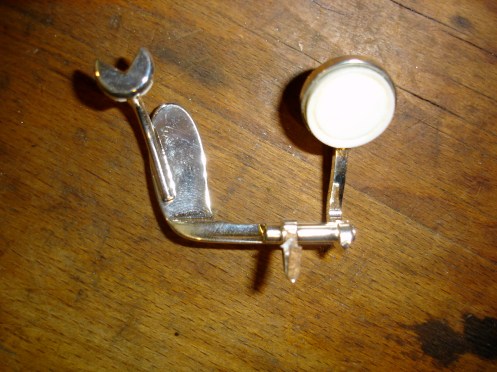
C/F Buffet key
Very often I have newly purchased Buffet R-13 clarinets brought in with the complaint that the left hand C/F lever is freezing up. The culprit: Buffet uses a synthetic cork under the mechanism, and the edge of the C/F lever cuts it in half. This causes the mechanism to hang or freeze up. It is a simple fix with a very thin layer of cork and teflon.

Buffet R-13 Lower Joint
 Inhorn Band Instrument Repair